

Program leader says NAMI affiliates provide valuable support
As a young teenager, Diamond Guitar-Judd remembers telling her mother about being depressed and having suicidal thoughts.
“I was told that I just needed to go to church more,” she said. “I grew up in a generation and in a family that didn’t talk about mental illness. You don’t talk about it, it doesn’t exist.”
She learned through her own struggles and those of her children and late husband that mental illness does exist. Those experiences were the catalyst for her wanting to help others.
Guitar-Judd is one of the program leaders for the affiliate program of NAMI Idaho (National Alliance on Mental Illness) in Pocatello. She has bachelor’s degrees in psychology and criminology and works as a recovery coach in addition to facilitating support groups. She mostly works with individuals with criminal histories with mental illness.
“Her nickname is Mother Goose around here because she’s out there rescuing all these strays so to speak,” said Johnnie Green, who was introduced to the NAMI program by Guitar-Judd. “She’s awesome. She’s done a lot for people in recovery and for NAMI.”
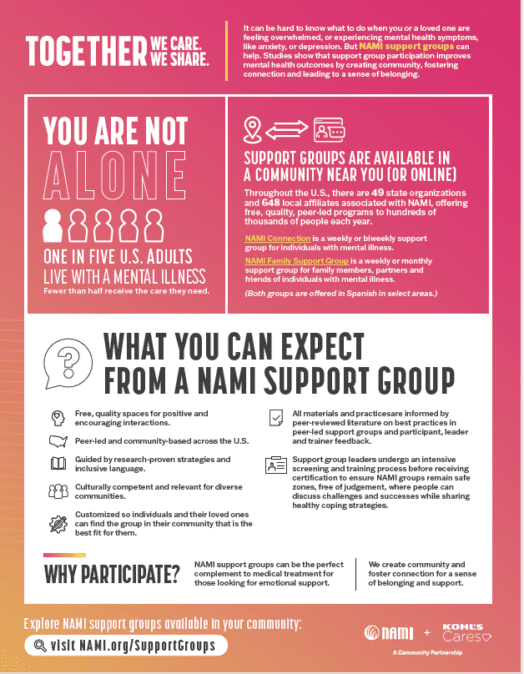
NAMI support groups are peer-led and offer participants an opportunity to share their experiences and gain support from other attendees. The Blue Cross of Idaho Foundation for Health provided grant funding to NAMI Idaho to start affiliate programs in Pocatello, Lewiston, and Twin Falls. These programs are critical, especially since Idaho has a severe shortage of mental health providers. Affiliate programs don’t replace medical professionals, but the support they provide is valuable to participants.
Guitar-Judd sees her role as a listener, something it took her a while to understand was the importance of lending an ear.
“I suffered tremendously by myself — that alone feeling, that feeling of nobody’s there to listen,” she said. “Those thoughts get loud, and I’m really thinking that I’d be better off, my family would be better off, without me. I didn’t have anybody for years that would listen, and then one of my best friends was sharing her story of dealing with her mental illness. And it was one of those, ‘oh, I’m not alone. I’m not crazy’ moments.”
Guitar-Judd is one of the first people who connects with individuals when they are released from prison via Wood Court, which is a justice-system program that fills a gap between mental health courts and drug courts.
“I spend the first four to six hours with them as we drive around and meet the treatment teams and get the resources they need,” she said. “One of the first things I ask is how’s your anxiety? How’s your stress level? They don’t need me to say anything – they just need a space.”
That’s how Green met Diamond-Judd. After being released from prison, Green was diagnosed with bipolar disorder, post-traumatic stress disorder and ADHD after Guitar-Judd encouraged him to be evaluated by a medical professional.
“When I found out I’m bipolar II, it allowed me to be able to say, ‘OK, so that’s why I respond this way, this is why I act this way.’ Having that awareness has been astronomical for myself.”
Diamond-Judd also told him about NAMI affiliate meetings.
“Once I started going to the meetings, I realized just how important this is,” he said. “Then I became part of the street team here.” Street teams consist of community volunteers who raise awareness and promote NAMI programs and events.
Green regularly provides peer support and mentorship to others who are experiencing what he’s gone through and works with several organizations to promote NAMI and help people get back on their feet.
“It’s keeping me very motivated,” he said. “I’m very passionate about NAMI. I’m passionate about mental illness. I’m passionate about helping people.”
That’s the purpose of NAMI Idaho affiliate programs — to help people suffering from mental health illness and let them know they are not alone.